
Emergency Medicine
Online ECG Interpretation Course for Doctors and Clinicians
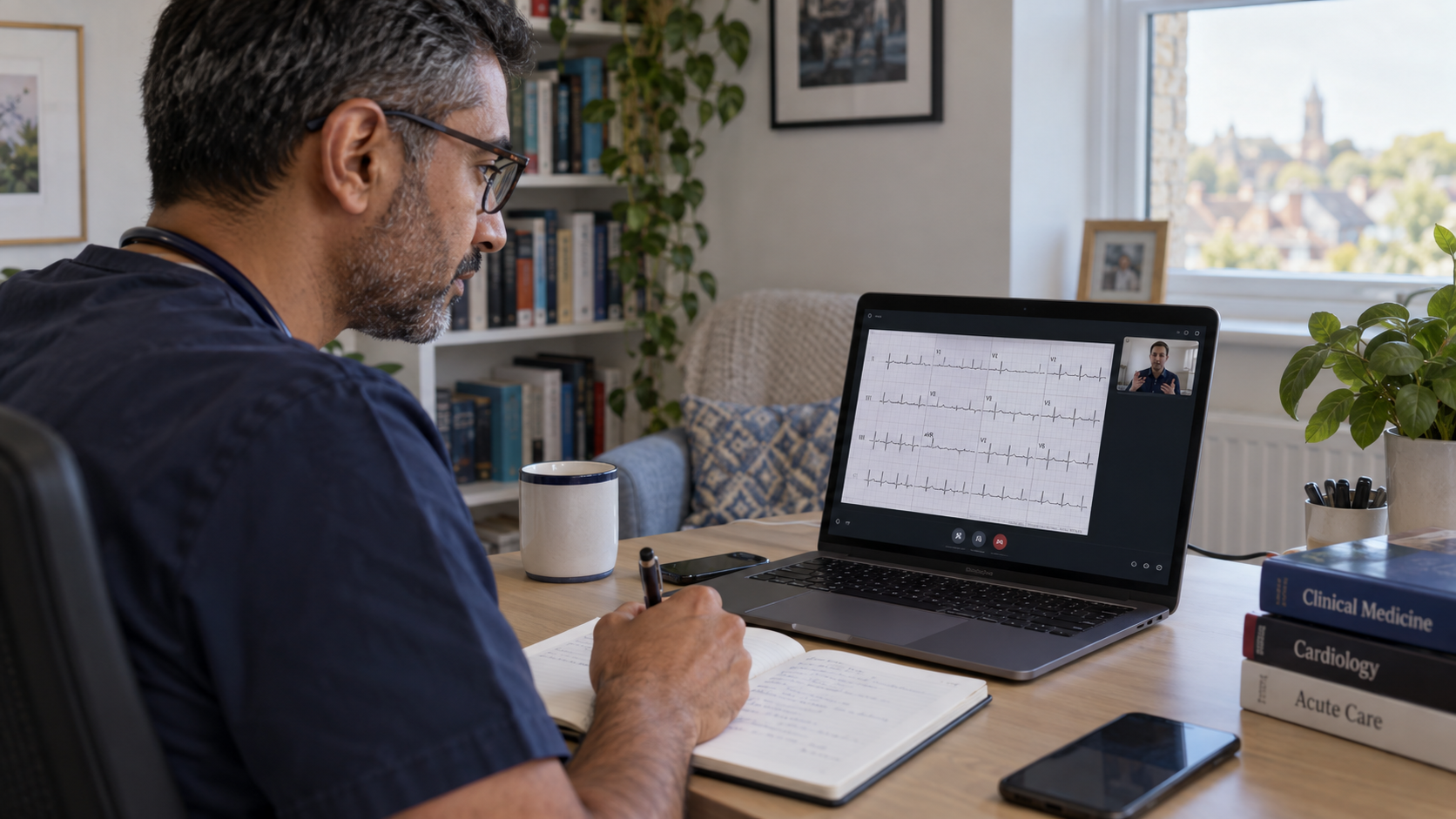
Our online ECG interpretation course gives doctors and healthcare professionals a clear, repeatable method for reading any 12-lead ECG. Taught live on Zoom by experienced clinicians, the day works through rhythm, conduction, ischaemia and electrolyte patterns using real clinical cases. It suits foundation doctors, trainees, international medical graduates, nurses and ACPs, and anyone preparing for MRCEM, FRCEM, PLAB or UKMLA. You receive a certificate and 6 self-certified CPD hours.
- Live clinician-led teaching, not pre-recorded
- 10:00 – 17:00, including one hour of breaks
- Joining link emailed after booking
- Structured 12-step ECG interpretation framework
- Case-based: chest pain, syncope, collapse and more
- Suitable for beginners and experienced ECG readers
- Certificate provided
- Join from a laptop or tablet for clear tracings
Course summary
- Duration
- 6 hours
- Format
- Online
- CPD
- 6
- Price
- £150
Not currently available
This course is not open for booking at the moment. Contact us and we will let you know when it is.
Ask about datesRead any ECG with a clear, systematic method
Do ECGs slow you down on the ward or in the emergency department? This online ECG interpretation course gives you a structured way to read a 12-lead ECG, spot what matters and decide what to do next. It is taught live on Zoom by experienced clinicians, so you can ask questions, test your reading against the instructor's and correct mistakes as they happen.
There is no travel, just one focused day of teaching built around real tracings. Whether you are new to ECGs or already read them but want more speed and consistency, you will leave with a method you can use on your next shift. Check the dates below, or send an enquiry if the next date has not been announced yet.
Why learn ECG interpretation online with Kung Medics
Kung Medics teaches practical medicine for doctors working in, or preparing to work in, UK clinical practice. Our ECG teaching is interactive from start to finish: you answer questions during the session, work through cases and talk through the tracings that most often cause confusion.
- Live and clinician-led: taught in real time by experienced clinicians, not a recorded lecture series.
- Context, not memorisation: each tracing is linked to a patient presentation and a clear next step.
- Exam-aware: practise verbalising findings for MRCEM, FRCEM and OSCE-style scenarios.
- Suited to IMGs: teaching designed with international medical graduates in mind.
Course overview
The course runs from 10:00 to 17:00 on Zoom, with one hour of breaks spread across the day. Teaching starts with a consistent framework you can apply to almost any 12-lead ECG: patient and technical details, rate, rhythm, axis, intervals, P waves, QRS complexes, ST segments, T waves, QT interval, overall interpretation, and clinical significance. You then apply it again and again to real tracings until it becomes automatic.
From there, you work through rhythm interpretation, heart block and conduction abnormalities, and myocardial ischaemia and infarction, which is one of the main focuses of the day. You then cover ECG changes caused by electrolyte and metabolic disturbances. Depending on the programme, teaching may also include pericarditis, ventricular hypertrophy, pre-excitation, long and short QT, Brugada-pattern recognition, paced rhythms and common artefacts.
ECGs are then placed inside clinical scenarios such as chest pain, syncope, palpitations, shock, sepsis and peri-arrest deterioration. That way you answer the questions that matter at the bedside: is this dangerous, does it explain the presentation, and who needs to know now? Throughout the day you compare your reading with the instructor's and learn the common mistakes to avoid.
Who this course is for
This course is for clinicians who recognise individual ECG abnormalities but lose confidence when faced with a complete tracing under time pressure. You will benefit if you find ECGs confusing, feel slow reading them, or want a dependable framework for clinical work and postgraduate exams.
It works for beginners building their first systematic approach and for experienced readers who want more speed and consistency. It is also useful if you are returning to acute practice or preparing for MRCEM, FRCEM, PLAB or UKMLA.
Who should attend
- Foundation doctors
- Internal Medicine trainees
- Emergency Medicine and Acute Medicine doctors
- General Practice trainees
- Anaesthetic and Critical Care trainees
- International medical graduates
- Nurses and advanced clinical practitioners who regularly review ECGs
- Clinicians returning to acute practice
Entry requirements
The course is suitable for beginners, so you do not need previous ECG training. Clinicians who already interpret ECGs are equally welcome.
What you need to attend
- A reliable internet connection
- A computer, laptop or tablet with working audio
- Access to the live teaching platform (Zoom)
- A quiet place to join from, where possible
- A notebook or device for notes
We recommend joining on a larger screen, because fine detail on ECG tracings can be hard to read accurately on a small phone display.
What you will learn
- Interpret a 12-lead ECG systematically using a repeatable framework
- Recognise common and dangerous rhythm abnormalities
- Identify conduction disturbances, including heart block and bundle branch block
- Recognise acute ischaemic changes and localise myocardial infarction
- Identify ECG changes linked to selected electrolyte and metabolic abnormalities
- Recognise ECG findings that need urgent escalation
- Describe ECG findings clearly and concisely
- Apply ECG findings to clinical scenarios and decide on next steps
Course content
-
1 A structured approach to the 12-lead ECG
Start every ECG the same way. Confirm quality and calibration, then work through rate, rhythm, axis, intervals and waveforms before forming an overall interpretation.By the end of this part you will be able to:
- Check ECG quality and calibration
- Calculate heart rate and assess the cardiac axis
- Measure PR, QRS and QT intervals
-
2 Rhythm interpretation
Sinus rhythms, atrial fibrillation and flutter, SVT, junctional rhythms, VT, VF, broad-complex tachycardia and bradyarrhythmias, approached logically rather than by pattern-spotting.By the end of this part you will be able to:
- Work through an unfamiliar rhythm step by step
- Separate stable rhythms from those needing immediate action
-
3 Heart block and conduction abnormalities
First-degree, Mobitz I, Mobitz II and complete heart block, right and left bundle branch block, bifascicular patterns and intraventricular conduction delay, including which need urgent escalation. -
4 Myocardial ischaemia and infarction
ST elevation and depression, T-wave inversion, pathological Q waves and reciprocal change. Covers inferior, anterior, lateral, posterior and right ventricular infarction, and high-risk ischaemic patterns, all read alongside the patient's symptoms and observations.By the end of this part you will be able to:
- Localise an infarct from the leads involved
- Spot reciprocal and posterior changes that are easily missed
-
5 Electrolyte and metabolic abnormalities
ECG changes in hyperkalaemia, hypokalaemia, hypercalcaemia, hypocalcaemia and hypothermia, and relevant drug effects, with emphasis on changes that signal an immediately life-threatening disturbance. -
6 Other important ECG patterns
Depending on the programme: pericarditis, ventricular hypertrophy, pulmonary embolism patterns, pre-excitation, long and short QT, Brugada-pattern recognition, paced rhythms, and common artefacts and technical errors. -
7 ECGs in the acutely unwell patient
Case-based practice in chest pain, syncope, palpitations, breathlessness, shock, collapse, sepsis, drug toxicity and peri-arrest deterioration. You decide whether the ECG is dangerous, whether it explains the presentation and whether senior review is needed. -
8 ECGs for MRCEM and FRCEM candidates
Rapid interpretation, clear verbal presentation of findings and management priorities in OSCE-style scenarios, plus the common exam errors to avoid. No confidential exam content is used.
Course format
- Duration
- 6 hours
- Delivery
- Live, interactive teaching on Zoom with case-based ECG practice
- Online learning
- 10:00 – 17:00, including one hour of breaks
- Learning hours
- 6
Training near you
This course is taught live online, so you can join from home or work anywhere with a reliable internet connection. There is no travel or parking to arrange.
Related courses
You may also like
-
 View course
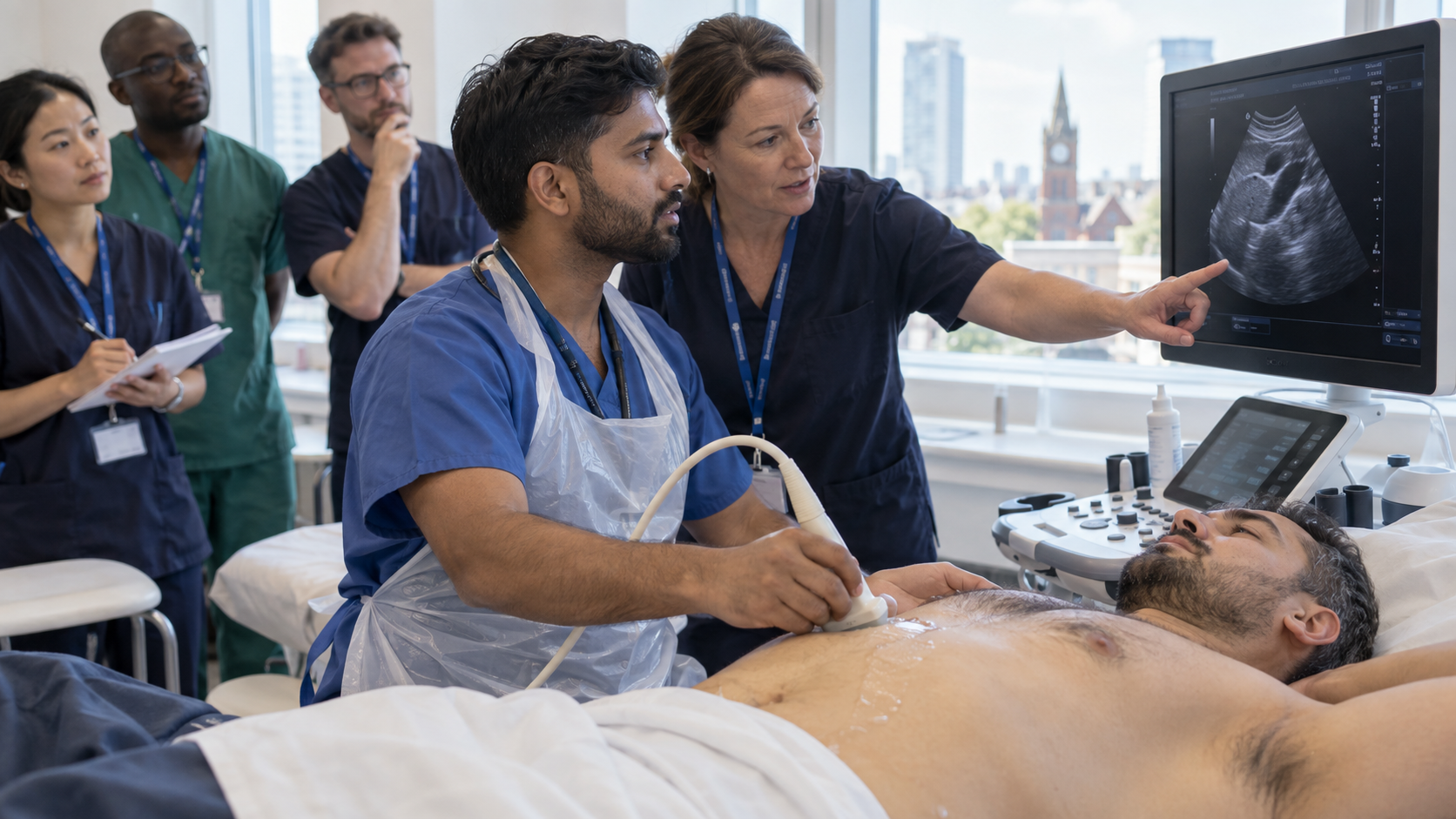
Core Emergency Ultrasound Level 1 (POCUS) Course in Manchester
This one-day POCUS course in Manchester gives doctors and acute-care clinicians supervised, hands-on practice in the core emergency ultrasound scans: the abdominal aorta, free…
Mon 26 Oct, PLAB Guide Training Centre
20 places available
See all Emergency Medicine coursesSee all FRCEM coursesSee all EM Skills Courses