EM Skills Courses
Ultrasound-Guided Peripheral Cannulation Course in Manchester
Practical Vascular Access Training by Kung Medics Develop the practical skills and confidence required to use ultrasound for peripheral intravenous cannulation , particularly in patients with difficult vascular access. The Ultrasound-Guided Cannulation Course by Kung Medics is a focused, hands-on training programme designed for doctors and healthcare professionals who want to improve their ability to identify suitable peripheral veins, visualise the needle and successfully obtain intravenous access using real-time ultrasound guidance.
Course summary
- Qualification
- The CPD Group
- Duration
- Half day
- Format
- Face-to-face
- Location
- Manchester
- CPD
- 4
- Price
- £180
- Next date
- Tuesday 27 October 2026
Practical Vascular Access Training by Kung Medics
Develop the practical skills and confidence required to use ultrasound for peripheral intravenous cannulation, particularly in patients with difficult vascular access.
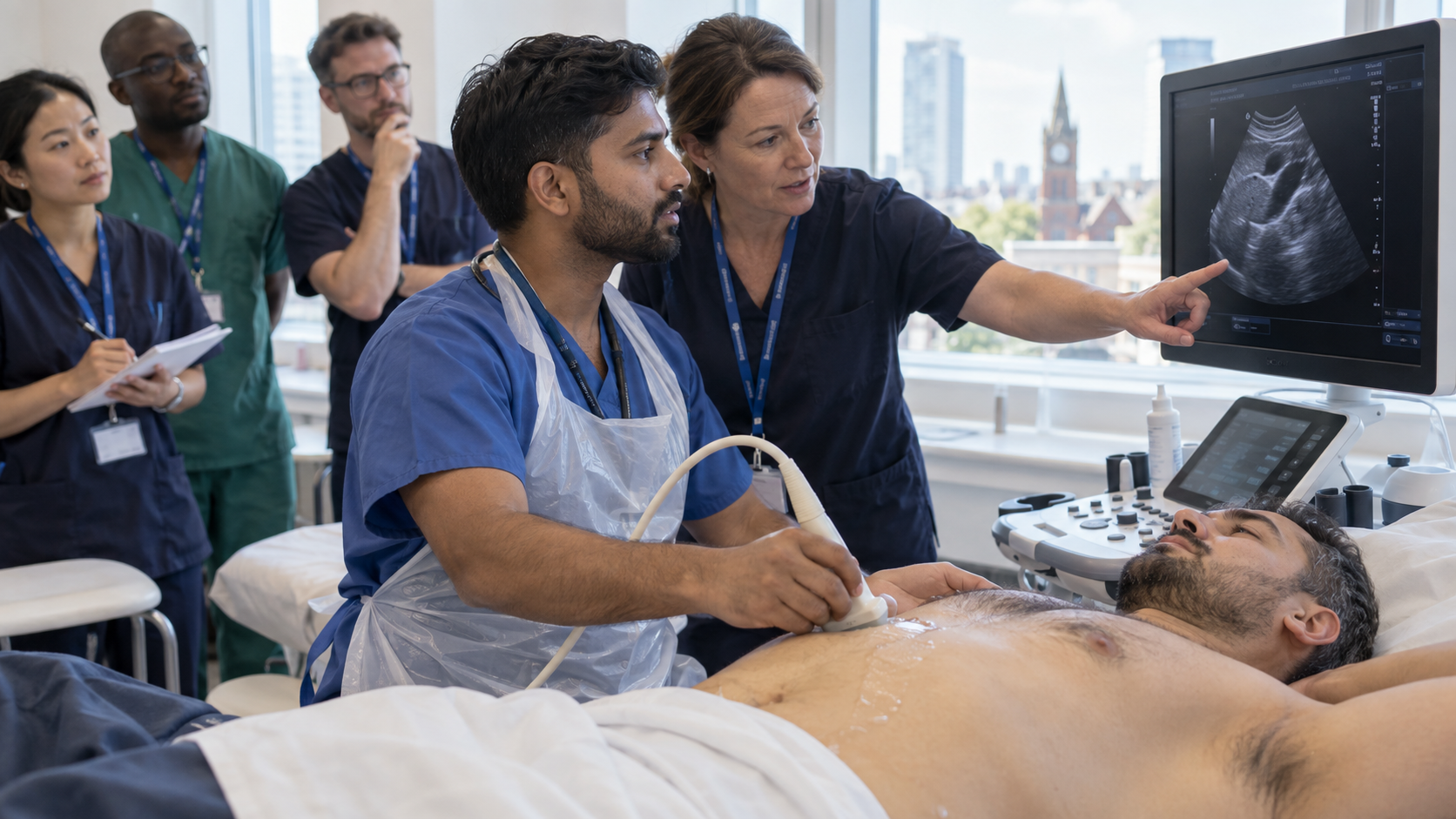
The Ultrasound-Guided Cannulation Course by Kung Medics is a focused, hands-on training programme designed for doctors and healthcare professionals who want to improve their ability to identify suitable peripheral veins, visualise the needle and successfully obtain intravenous access using real-time ultrasound guidance.
The course is especially useful for clinicians who are comfortable with standard cannulation but find difficult-access patients challenging.
Who Is This Course For?
This course is suitable for:
-
Foundation doctors
-
Emergency Medicine doctors
-
Internal Medicine trainees
-
Acute Medicine doctors
-
Anaesthetic and Critical Care trainees
-
Surgical trainees
-
Advanced clinical practitioners
-
Physician associates
-
Nurses working in acute or emergency settings
-
International Medical Graduates entering UK clinical practice
-
Clinicians who frequently encounter difficult intravenous access
-
Healthcare professionals who want supervised ultrasound-guided vascular access practice
Basic cannulation experience is recommended.
What You Will Learn
During the course, candidates develop a structured approach to:
-
Understanding indications for ultrasound-guided cannulation
-
Recognising when ultrasound may improve vascular access success
-
Selecting an appropriate ultrasound probe
-
Optimising the ultrasound image
-
Identifying veins and arteries
-
Assessing vessel depth, diameter and patency
-
Selecting an appropriate cannula
-
Planning the puncture site
-
Maintaining aseptic technique
-
Performing real-time ultrasound-guided needle insertion
-
Visualising the needle tip
-
Advancing the cannula safely
-
Troubleshooting unsuccessful attempts
-
Recognising common complications
-
Documenting the procedure appropriately
Ultrasound Assessment of Peripheral Veins
Candidates learn how to scan the upper limb systematically and identify suitable vessels for cannulation.
Training includes:
-
Probe orientation
-
Short-axis vessel assessment
-
Long-axis vessel assessment
-
Differentiating veins from arteries
-
Assessing compressibility
-
Identifying vessel depth
-
Assessing vessel size
-
Recognising surrounding structures
-
Selecting the safest and most practical target vessel
The course also discusses how vessel depth influences cannula length and procedural success.
Needle Visualisation
A major focus of the course is learning how to maintain awareness of the needle tip during ultrasound-guided insertion.
Candidates practise:
-
Out-of-plane needle guidance
-
In-plane needle guidance
-
Coordinating probe and needle movement
-
Recognising the needle tip
-
Avoiding advancement when the tip is not visualised
-
Correcting poor alignment
-
Following the needle toward the vessel
-
Confirming entry into the lumen
Understanding the difference between visualising part of the needle and confidently identifying the needle tip is strongly emphasised.
Cannula Selection
Candidates are introduced to practical considerations when choosing an intravenous cannula, including:
-
Vessel diameter
-
Vessel depth
-
Cannula length
-
Intended clinical use
-
Required flow rates
-
Expected duration of access
-
Patient comfort
-
Risk of dislodgement or infiltration
Deeper vessels may require longer cannulas to improve stability and reduce early failure.
Practical Cannulation Technique
Candidates work through a structured ultrasound-guided cannulation sequence:
-
Assess the patient and indication
-
Select an appropriate vein
-
Prepare equipment
-
Apply aseptic technique
-
Position the ultrasound probe
-
Identify the vessel
-
Insert and visualise the needle
-
Confirm entry into the vein
-
Advance the cannula
-
Confirm patency
-
Flush and secure the line
-
Document the procedure
Difficult Intravenous Access
The course is particularly relevant when peripheral access is difficult because of:
-
Obesity
-
Chronic illness
-
Previous chemotherapy
-
Intravenous drug use
-
Multiple previous cannulation attempts
-
Poorly visible or palpable veins
-
Oedema
-
Dehydration
-
Long-term hospitalisation
-
Chronic vascular access problems
Candidates learn when continuing blind attempts may be less appropriate than moving to an ultrasound-guided approach.
Infection Prevention and Safety
Candidates review:
-
Hand hygiene
-
Appropriate PPE
-
Skin preparation
-
Cleaning ultrasound equipment
-
Probe covers where appropriate
-
Maintaining a clean working field
-
Safe sharps disposal
-
Correct dressing and securement
-
Avoiding unnecessary repeated punctures
Complications
Training includes recognition and prevention of potential complications such as:
-
Arterial puncture
-
Haematoma
-
Extravasation
-
Infiltration
-
Nerve irritation or injury
-
Infection
-
Thrombophlebitis
-
Failed cannulation
-
Cannula dislodgement
-
Early line failure
Candidates are encouraged to recognise when an attempt should be stopped and when more experienced assistance is required.
Hands-On Practical Training
This course is highly practical.
Candidates have opportunities to:
-
Use ultrasound machines
-
Practise probe orientation
-
Identify simulated vessels
-
Practise short-axis and long-axis views
-
Perform needle-guidance exercises
-
Cannulate vascular access models
-
Repeat difficult techniques
-
Receive immediate instructor feedback
-
Correct common errors
-
Develop hand-eye coordination
The emphasis is on repeated, supervised practice rather than observation alone.
Why Learn Ultrasound-Guided Cannulation?
Ultrasound-guided peripheral access can be particularly valuable in patients who would otherwise require multiple unsuccessful attempts.
Developing this skill may help clinicians:
-
Reduce repeated cannulation attempts
-
Improve confidence with difficult access
-
Improve patient experience
-
Escalate vascular access more appropriately
-
Avoid unnecessary central venous access in selected patients
-
Develop broader POCUS and procedural skills
Preparing for Clinical Competency
This course provides simulation-based education and practical skill development.
Candidates should continue their training through:
-
Supervised clinical cannulations
-
Workplace-based competency assessments
-
Procedure logbooks
-
Direct observation
-
Local vascular access policies
-
Ongoing ultrasound practice
Candidates must work within their professional scope and local governance arrangements.
Why Train With Kung Medics?
Candidates benefit from:
-
Practical ultrasound-focused teaching
-
Experienced clinical instructors
-
Vascular access simulation models
-
Repeated hands-on practice
-
Small-group teaching
-
Immediate feedback
-
Structured step-by-step instruction
-
Training suitable for clinicians lacking confidence
-
A supportive learning environment
-
Teaching focused on real clinical application
Our aim is to help candidates develop a simple, reproducible technique that they can continue refining under appropriate clinical supervision.
Learning Outcomes
By the end of the course, candidates should have a better understanding of how to:
-
Identify suitable peripheral veins using ultrasound
-
Differentiate veins from arteries
-
Optimise ultrasound images
-
Select an appropriate vessel and cannula
-
Use in-plane and out-of-plane techniques
-
Maintain awareness of the needle tip
-
Cannulate a simulated vessel using real-time ultrasound
-
Recognise common procedural complications
-
Troubleshoot unsuccessful attempts
-
Continue toward supervised clinical competency
Important Course Status
The Ultrasound-Guided Peripheral Cannulation Course is an independent practical training programme delivered by Kung Medics.
Completion of this course:
-
Does not by itself certify independent clinical competence
-
Does not replace workplace supervision
-
Does not replace employer competency assessment
-
Does not authorise independent practice where local sign-off is required
Candidates must follow local policies and practise within their individual scope of competence.
Book Your Ultrasound-Guided Cannulation Course
If difficult intravenous access makes you hesitant or you want to develop greater confidence with bedside ultrasound, this course provides focused practical training in a supportive environment.
Book your Ultrasound-Guided Cannulation Course with Kung Medics and develop the skills needed to progress toward safe, effective ultrasound-guided peripheral vascular access.
Upcoming dates
£180
Book this dateMore dates
Choosing a date takes you straight to booking with that date selected.
Course format
- Duration
- Half day
- Delivery
- Small-group, hands-on practice with simulation and expert feedback
- Classroom
- 9:00am – 1:00pm
Training near you
Venue hired by Kung Medics for course delivery, at 308 Moseley Road, Levenshulme, Manchester M19 2LH.
Related courses
You may also like
-
 View course
Core Emergency Ultrasound Level 1 (POCUS) Course in Manchester
This one-day POCUS course in Manchester gives doctors and acute-care clinicians supervised, hands-on practice in the core emergency ultrasound scans: the abdominal aorta, free…
Mon 26 Oct, PLAB Guide Training Centre
20 places available
-
View course
Ultrasound-Guided Central Venous Access Course in Manchester
Practical Central Line Insertion Training by Kung Medics Develop the practical knowledge, ultrasound skills and procedural confidence required to perform ultrasound-guided…
Tue 27 Oct, PLAB Guide Training Centre
9 places available
-
View course
Ultrasound-Guided Chest Drain Insertion Course in Manchester
Practical Pleural Procedure Training by Kung Medics Develop the ultrasound, anatomical and procedural skills required to perform ultrasound-guided chest drain insertion safely…
Wed 28 Oct, PLAB Guide Training Centre
7 places available
-
View course
Ultrasound-Guided Fascia Iliaca Block Course in Manchester
Practical Regional Anaesthesia Training by Kung Medics Develop the ultrasound, anatomical and procedural skills required to perform an Ultrasound-Guided Fascia Iliaca Block…
Wed 28 Oct, PLAB Guide Training Centre
10 places available
-
View course
Ultrasound-Guided Lumbar Puncture Course in Manchester
Practical Procedural Ultrasound Training by Kung Medics Develop the anatomical, ultrasound and procedural skills required to perform ultrasound-assisted and ultrasound-guided…
Thu 29 Oct, PLAB Guide Training Centre
20 places available
Ready to book?
The next date with places is Tuesday 27 October 2026
Book now