
Emergency Medicine
ED Team Leader Course for MRCEM OSCE in Manchester
Our MRCEM OSCE team leader course in Manchester is a one-day, scenario-based programme for emergency medicine doctors who know the algorithms but need to lead with confidence. You take the ED Team Leader role in adult, paediatric and major trauma resuscitation stations, then receive structured feedback on leadership, delegation, communication and OSCE technique. Includes a course certificate and CPD. An independent exam-preparation course, not an ALS, APLS or ATLS provider course.
- Day runs 10am – 5pm
- Lead every scenario as the ED Team Leader
- Adult, paediatric and major trauma scenarios
- Structured feedback and debrief after each station
- Small groups led by experienced senior clinicians
- Repeat difficult scenarios to apply feedback
- Also relevant to FRCEM OSCE preparation
- Independent course – not an ALS/APLS/ATLS course
Course summary
- Duration
- 1 day
- Format
- Face-to-face
- Location
- Manchester
- CPD
- 6
- Price
- £200
- Next date
- Saturday 31 October 2026
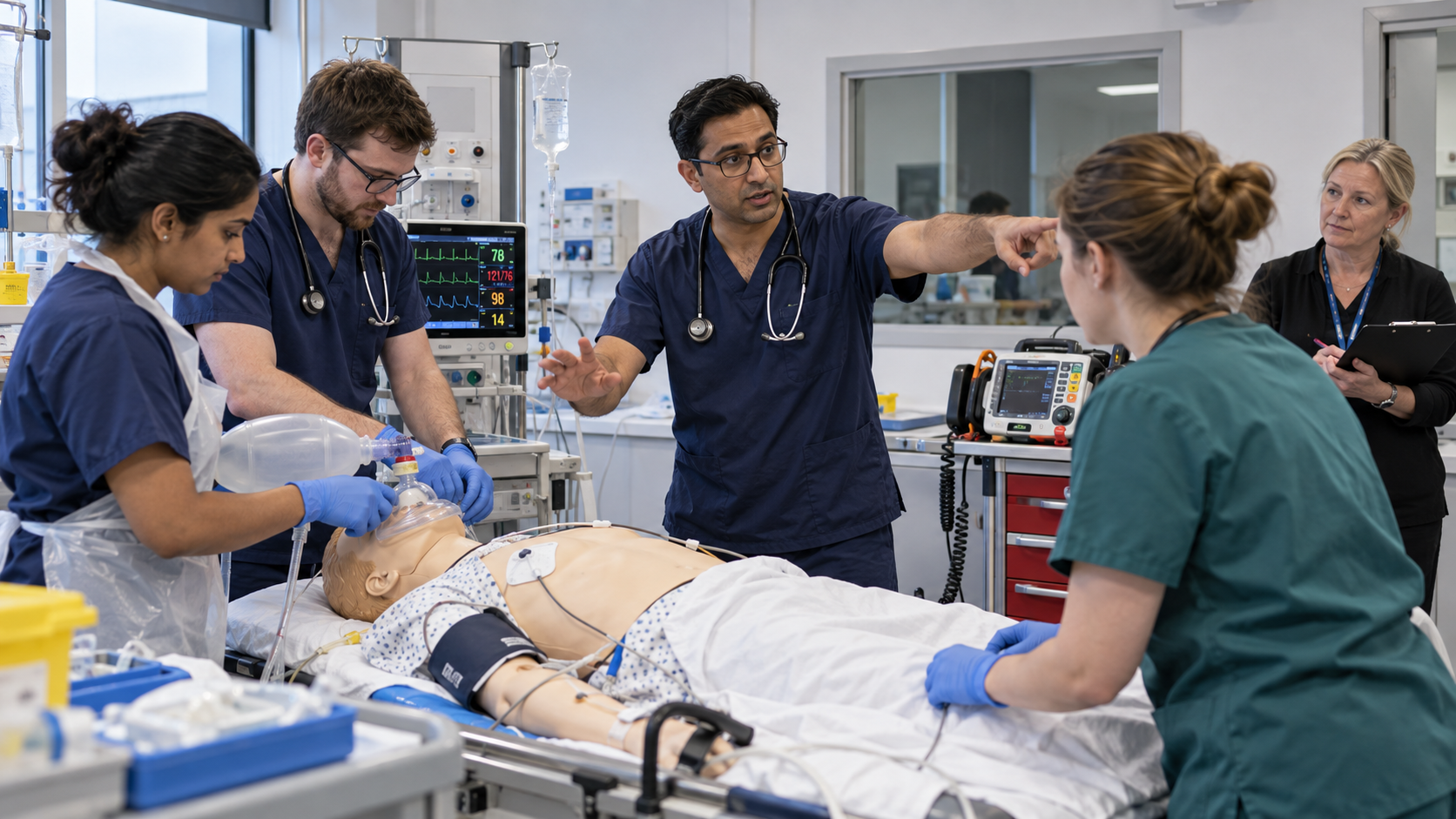
MRCEM OSCE team leader training in Manchester
Knowing the ALS algorithm is not the same as running the resus room. In the MRCEM OSCE, team-leader stations reward the candidate who takes control early, gives clear instructions, reassesses after every intervention and talks the examiner through their thinking. This one-day MRCEM OSCE team leader course in Manchester is built around exactly that.
At the Levenshulme venue you'll lead adult, paediatric and trauma scenarios as the ED Team Leader, with a team, changing observations and examiner prompts. After each station you get structured feedback, then the chance to run a difficult scenario again. Check the upcoming dates below and reserve your place.
Why prepare for the MRCEM OSCE with Kung Medics
Our teaching is focused on emergency medicine and delivered by experienced senior clinicians in small groups, so you spend the day leading scenarios rather than watching from the back of a lecture room.
- Repeated team-leader practice across adult, paediatric and major trauma stations
- Immediate, structured feedback on priorities, delegation, escalation and OSCE technique
- A repeatable framework that keeps you organised when the scenario changes
- A supportive setting for candidates who lack confidence or lose structure under time pressure
The goal is simple: to move you from knowing what should happen to leading it calmly and safely.
Upcoming MRCEM OSCE team leader course dates in Manchester
£200
Book this dateChoosing a date takes you straight to booking with that date selected.
Course overview
The day is organised around one idea: in a resuscitation station, the team leader is judged on how they run the scenario, not only on reaching the diagnosis. You start with a repeatable leadership framework – immediate safety and overview, calling for help, allocating roles, a structured ABCDE assessment, treating problems as you find them, reassessing, identifying reversible causes, escalating and planning disposition – and then put it into practice.
Candidates rotate through realistic stations in the ED Team Leader role. Scenarios may include a simulated patient, team members, changing observations, investigation results, sudden deterioration, interruptions and examiner prompts. Each station is followed by a detailed debrief, and you can repeat difficult scenarios to apply the feedback straight away.
Teaching draws on principles from adult and paediatric advanced life support, European paediatric advanced life support and ATLS-style trauma assessment, alongside crisis resource management and closed-loop communication.
Course status: this is an independent exam-preparation and clinical-skills programme. It is not an official ALS, APLS, EPALS or ATLS course, does not award provider certification and does not replace provider-course training. It does not reproduce confidential examination content and does not guarantee success in the MRCEM or FRCEM examination.
Who this course is for
This course is for emergency medicine doctors who understand resuscitation algorithms but lose structure when they have to lead. If you become disorganised under time pressure, hesitate to delegate, find resus stations overwhelming or struggle to put your priorities into words, you'll get realistic practice in the role before exam day.
It is designed primarily for the MRCEM OSCE, but the same leadership skills carry over to FRCEM OSCE preparation, workplace-based assessments, simulation training and leading real resuscitation teams.
Who should attend
- Doctors preparing for the MRCEM OSCE
- Emergency medicine trainees
- Doctors working in the emergency department
- International medical graduates preparing for UK emergency medicine examinations
- Candidates preparing for the FRCEM OSCE
- Doctors with ALS, APLS, EPALS or trauma knowledge who want team-leader simulation practice
What you will learn
- Take control of an emergency department resuscitation scenario and establish leadership early
- Apply a structured ABCDE approach consistently under time pressure
- Delegate tasks clearly using closed-loop communication
- Apply adult and paediatric resuscitation principles as team leader
- Lead a structured primary survey in major trauma
- Recognise deterioration, reassess after interventions and identify reversible causes
- Escalate appropriately while maintaining situational awareness
- Verbalise your clinical reasoning and give a clear handover and disposition plan
Course content
-
1 The team-leader framework
A repeatable structure for entering the station, taking an overview, calling for help and allocating roles, then working through ABCDE, reassessment, escalation and disposition.By the end of this part you will be able to:
- Open a station with a clear plan and introduce yourself as l
- Allocate roles before starting hands-on tasks
- Summarise the scenario clearly to the examiner
-
2 Communication, delegation and crisis resource management
Short, direct instructions to named team members with confirmation and follow-up, alongside crisis resource management principles such as sharing the mental model, workload distribution and avoiding fixation errors.By the end of this part you will be able to:
- Run a full closed loop: instruct, name, confirm, complete, r
- Challenge an unsafe action appropriately
- Recognise when the plan isn't working and change course
-
3 Adult resuscitation scenarios
Leading adult emergencies based on advanced life-support principles. Scenarios may include cardiac arrest, peri-arrest arrhythmias, severe respiratory failure, anaphylaxis, sepsis, major haemorrhage, electrolyte and toxicological emergencies, and post-resuscitation care.By the end of this part you will be able to:
- Lead shockable and non-shockable cardiac arrest scenarios
- Manage peri-arrest deterioration while keeping the team info
-
4 Paediatric resuscitation scenarios
Leading emergencies in infants and children. Scenarios may include respiratory failure, shock, cardiac arrest, seizures, anaphylaxis, sepsis, trauma and reduced consciousness.By the end of this part you will be able to:
- Adapt communication, equipment and treatment priorities for
- Lead a deteriorating infant or child scenario with a clear s
-
5 Trauma team leadership
An ATLS-style approach to leading the trauma team, from activation and the primary survey to catastrophic haemorrhage, major haemorrhage protocols, imaging and specialist involvement.By the end of this part you will be able to:
- Coordinate a primary survey with cervical spine protection
- Plan transfer to theatre, interventional radiology or critic
-
6 OSCE technique and common team-leader mistakes
Making your reasoning visible to the examiner without becoming verbose, and avoiding frequent errors such as skipping the overview, doing every task yourself or ending the station without a disposition.By the end of this part you will be able to:
- Say what worries you and what you expect to happen next
- Respond to new information without losing structure
- Finish every station with a handover and disposition
Course format
- Duration
- 1 day
- Delivery
- Small-group scenario-based simulation with structured debriefs
- Classroom
- 10am – 5pm
Assessment
- How you are assessed
- You receive structured feedback after every scenario on clinical priorities, leadership, communication, delegation, escalation and OSCE technique.
Related courses
You may also like
-
 View course
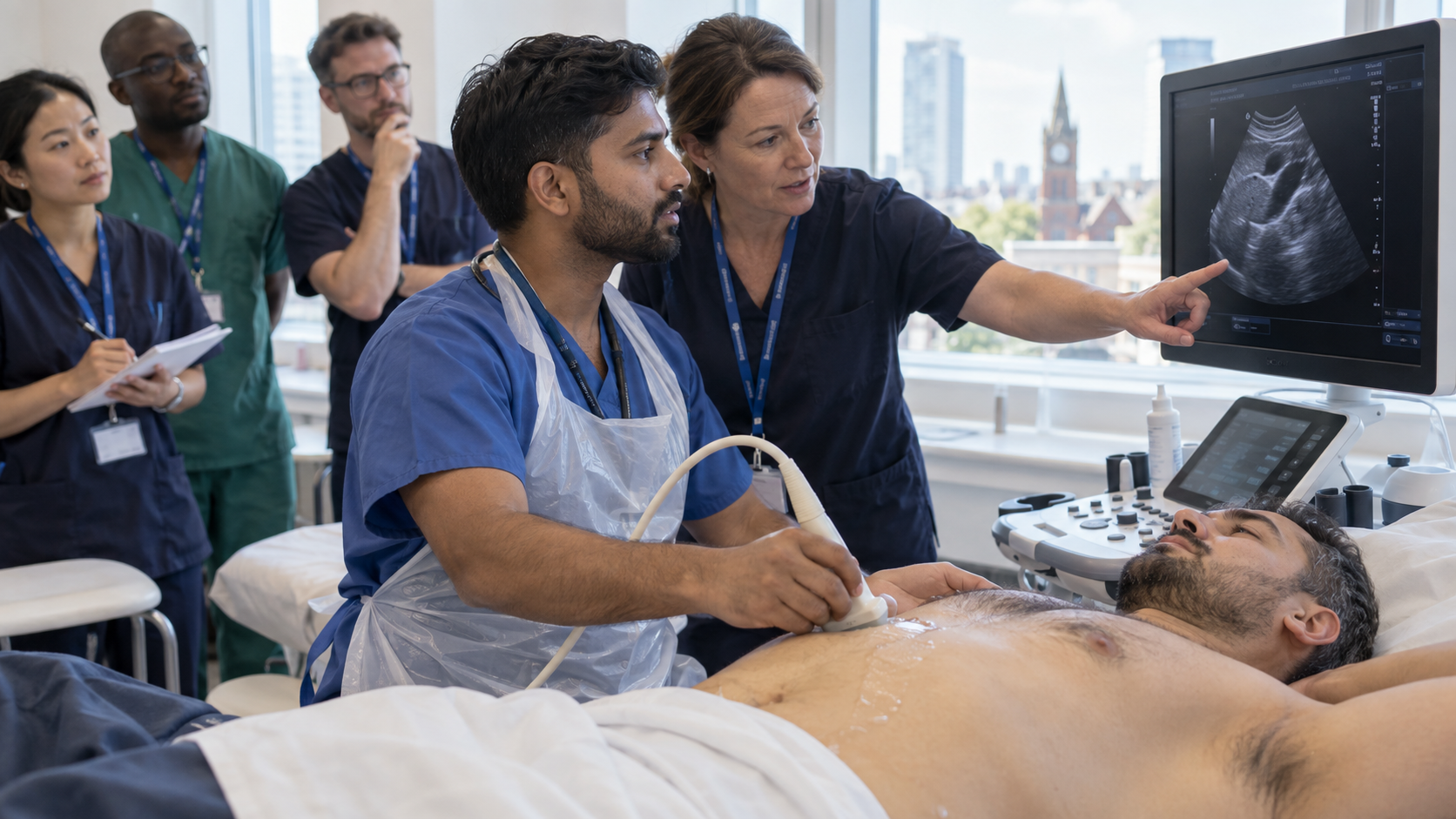
Core Emergency Ultrasound Level 1 (POCUS) Course in Manchester
This one-day POCUS course in Manchester gives doctors and acute-care clinicians supervised, hands-on practice in the core emergency ultrasound scans: the abdominal aorta, free…
Mon 26 Oct, PLAB Guide Training Centre
20 places available
-
 View course
Online ECG Interpretation Course for Doctors and Clinicians
Our online ECG interpretation course gives doctors and healthcare professionals a clear, repeatable method for reading any 12-lead ECG. Taught live on Zoom by experienced…
No dates scheduled
See all Emergency Medicine coursesSee all MRCEM coursesSee all FRCEM coursesSee all EM Skills Courses
Frequently asked questions
Is this an official ALS, APLS or ATLS course?
Will I receive a certificate and CPD?
How is the day taught?
Is the course useful for the FRCEM OSCE?
Is it suitable for international medical graduates?
Where is the course held and what are the times?
Will I practise real MRCEM exam stations?
What is the cancellation policy?
Can my employer pay for my place?
Ready to book?
The next date with places is Saturday 31 October 2026
Book now